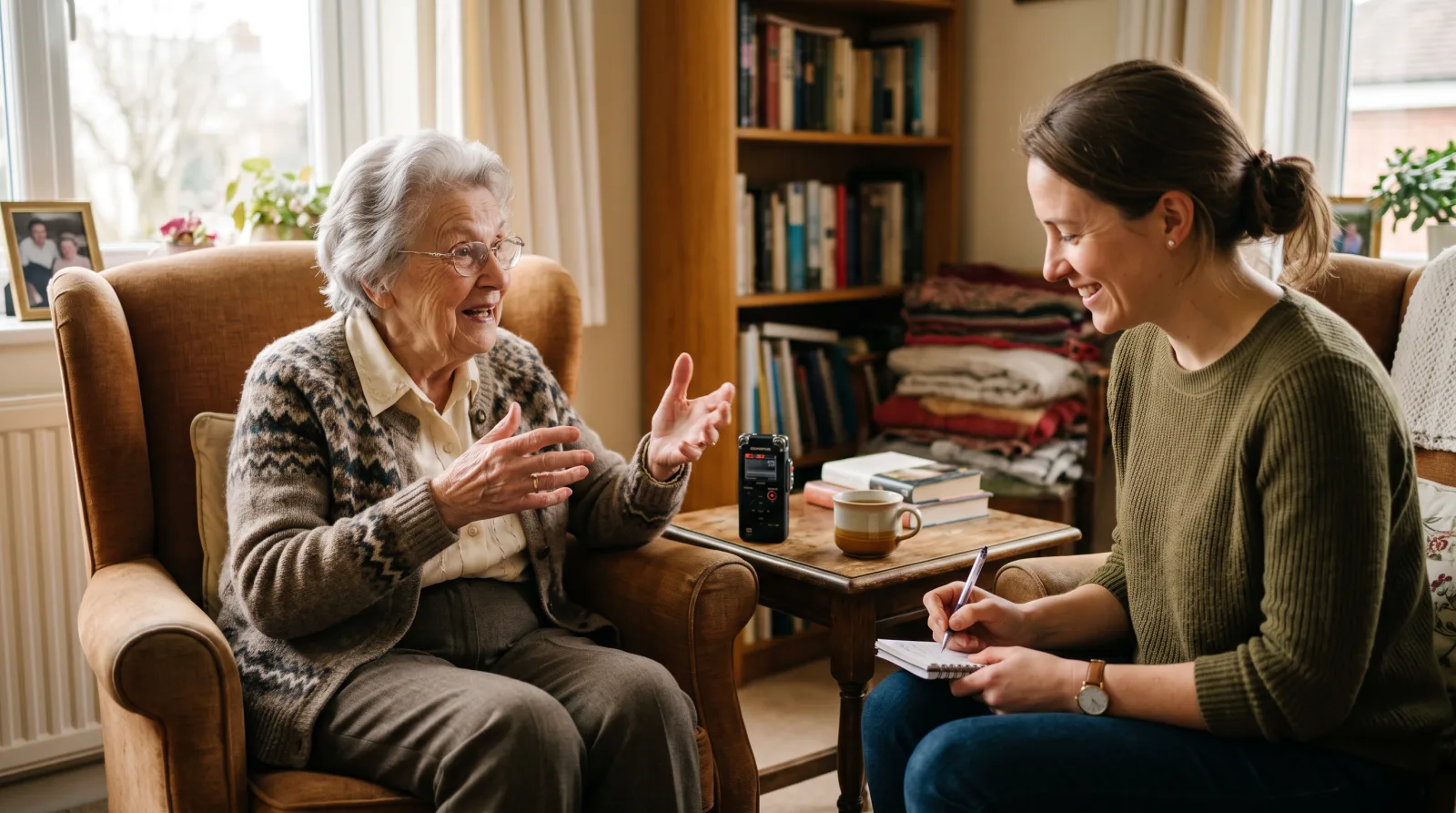
Before you dive into archives and databases, talk to the living libraries in your family.
Your goal: use the Family Interview Guide to capture memories that a census record could never tell you.
Pro tip: ask for the story, not the date
Do not just ask “When were you born?” Ask the questions that spark a story:
- What is one memory from your childhood that still makes you smile?
- Is there a family tradition, recipe, or saying that has been passed down? What does it mean to you?
- Who had the greatest influence on the person you became, and what did they teach you?
- If you could tell your grandchildren one thing about our family’s story, what would it be?
Not feeling these questions? Try asking about the senses: What did your grandmother’s kitchen smell like? or What was the loudest sound in your childhood home?
What is on the worksheet
Page one collects the facts — full name, maiden name, nicknames, birth date and place, parents, where the family came from, spouse, children, and a table for brothers and sisters. Page two is the part people remember: the four questions above, with room to write.
There is also a short reminder at the top: find a quiet time, ask before you record, let them tell it their way, and skipping a question is always okay.
Bonus: the professional touch
In genealogy we cite our sources so others can find the truth. To cite your interview in Chicago style (17th ed.), use this format:
Name of person interviewed, interview by [Your Name], [Date of interview], [Location or Medium, e.g. Zoom or Phone].
Write that line at the top of your notes while you still remember the date. Future you will be grateful.
Try it
Read the memory below, then click the details you could go looking for.